The market pull toward a circular economy: Why demand is rising
Market forces are making the circular economy a compelling commercial opportunity, not just a sustainability ambition. As demand from customers, investors, and supply chain partners grows, circular business models are emerging as a new source of value creation and competitive advantage. Companies that act early can capture market share, strengthen resilience, and lead in a future where circularity is not just expected, but rewarded.

Fast forward fifteen years from now – if not sooner – and circular economy transformation will have happened. Some business leaders may resist the idea of a circular new normal, given the risks that come with business model innovation. However, plenty already see this inevitable challenge as an opportunity to move ahead of competitors and build resilience for the future.
What’s driving their embrace of circularity?
Circular innovation is the next value creation opportunity
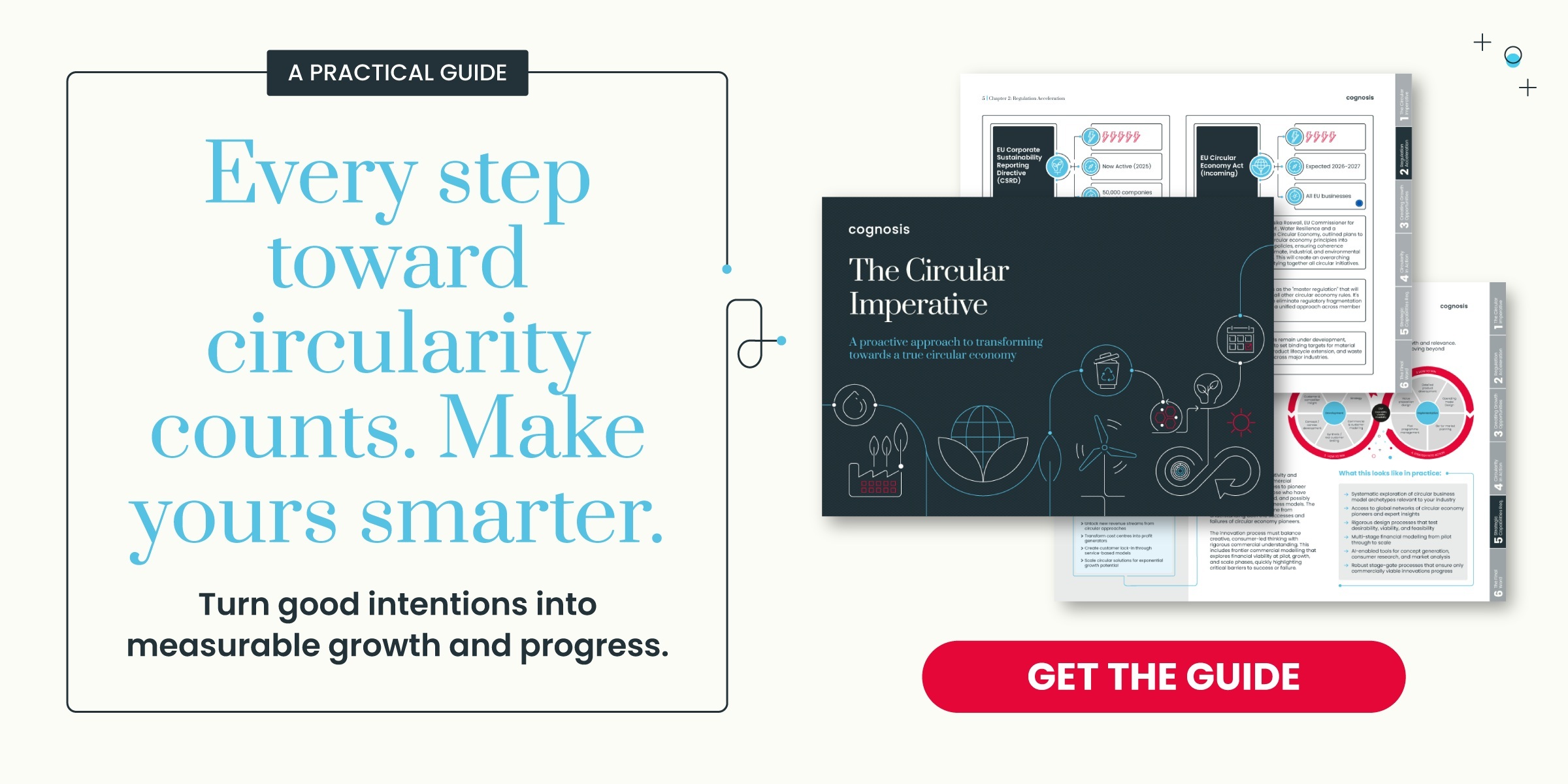
In the first of our two-part series, we looked at the Push of regulatory change, as governments draw up legislation and standards to mandate circularity this decade. Circularity will be forced to shift from a voluntary ambition to an enforceable obligation.
> READ PART 1: The regulatory push toward a circular economy: How policy is forcing change
This second article examines the Pull of market forces that are providing a strong commercial case for change. We’ll focus on why market conditions now favour circularity, the sources of demand driving adoption, and where value is created by acting early.
Together, the Push and Pull signal that the world is ready for circularity, and that urgency matters.
Powerful forces are gathering
The market pull for circular innovation is coming from four different sources.
1. Consumer demand is shifting from niche to conventional
For many years, sustainability was seen as specialised. Once the preserve of health shops and mail orders, green products can now be found across all supermarket aisles, retail platforms and the high street. Even with the cost-of-living pinch, more than four-fifths of UK consumers will stump up 10% more for goods that are sourced locally, use recycled materials or demonstrably low-carbon. Research shows that Gen-Zers have a greater understanding and commitment to social and environmental causes than their parents, and they are prepared to pay for their convictions.
2. Investors are looking for both profit and purpose
Impact investing has also moved from the margins to the mainstream. In 2024, the UK impact investment market reached £77 billion, growing faster than the broader asset management sector at just under 10% annually. Globally, investment in the circular economy swelled from $10 billion in 2018 to $28 billion in 2023.Circular, resource-efficient business models are attracting premium valuations due to stronger risk-adjusted returns and alignment with resilient, long-term value creation.
3. Supply chain reaction is galvanising circularity
Procurement has become a fertile ground for circularity, with major organisations selecting suppliers that can transparently demonstrate their sustainability credentials. Tech giant Microsoft insists that suppliers meet high standards related to climate emissions, while household names such as Walmart, Mars and General Motors have set up schemes to reward suppliers for green practices. Faced with input cost volatility and supply risk, COOs are prioritising reliable sourcing for operational resilience, including closed-loop systems. For example, Porsche has entered a strategic partnership with Hydro Aluminium Metal to recycle aluminium, which can save up to 95% in energy costs, compared to virgin production.
4. The price is increasingly right
Historically, return on investment has been at odds with circular innovation, but the financials are starting to add up. Many circular models now compete with – or even outperform – linear models on cost and margins, due to resource efficiency, new revenue streams and enhanced customer relationships. For example, Swedish engineering firm SKF offers an Oil-as-a-Service subscription service that continuously reconditions lubricants, transforming oil into a reusable resource, reducing waste, lowering costs and improving machine performance for customers. Technology for circularity is also becoming more mature and accessible, encouraging traceability, reverse logistics and material recovery at scale.
From window of opportunity to table stakes
The clock is ticking. In just a few years, competitive spaces will become more crowded and differentiation harder to achieve. But we’re not there yet. The window is still open.
Those early movers who approach circularity not as compliance – but a venture – can still target lower costs, stronger customer loyalty, strategic supply partners, new revenue and a lasting edge. First movers will have the track record to tell a more authentic story. As circularity becomes table stakes, scrutiny will increase, in step with greenwashing risks.
The circular economy represents both an existential obligation and one of the greatest commercial opportunities of our time. The future will be circular. The question is whether businesses choose to create that future, or be created by it.