Taking the first (and likely hardest) step towards circularity
Does your organisation have a circular economy strategy? It could be part of the entire business strategy already – or something you’ve never mentioned before in a board meeting. The very thought of developing circular business models may sound terrifying. Here are four action points to get your journey started.

The shift to circular business models will almost certainly become the biggest single corporate transformation in the next 30 years. In fact, when we look back in 2050 or 2060, we may wonder how the world ever functioned in a linear way. Circularity will be the norm – and business will have led the change.
Two powerful forces make this transition both essential and inevitable. Firstly, the traditional linear model of “take, make, dispose” is unsustainable. Our planet’s resources cannot cope with the rate of extraction. The second driver is commercial, as the circular economy brings the promise of profitability and resilience for those businesses that can adapt fastest.
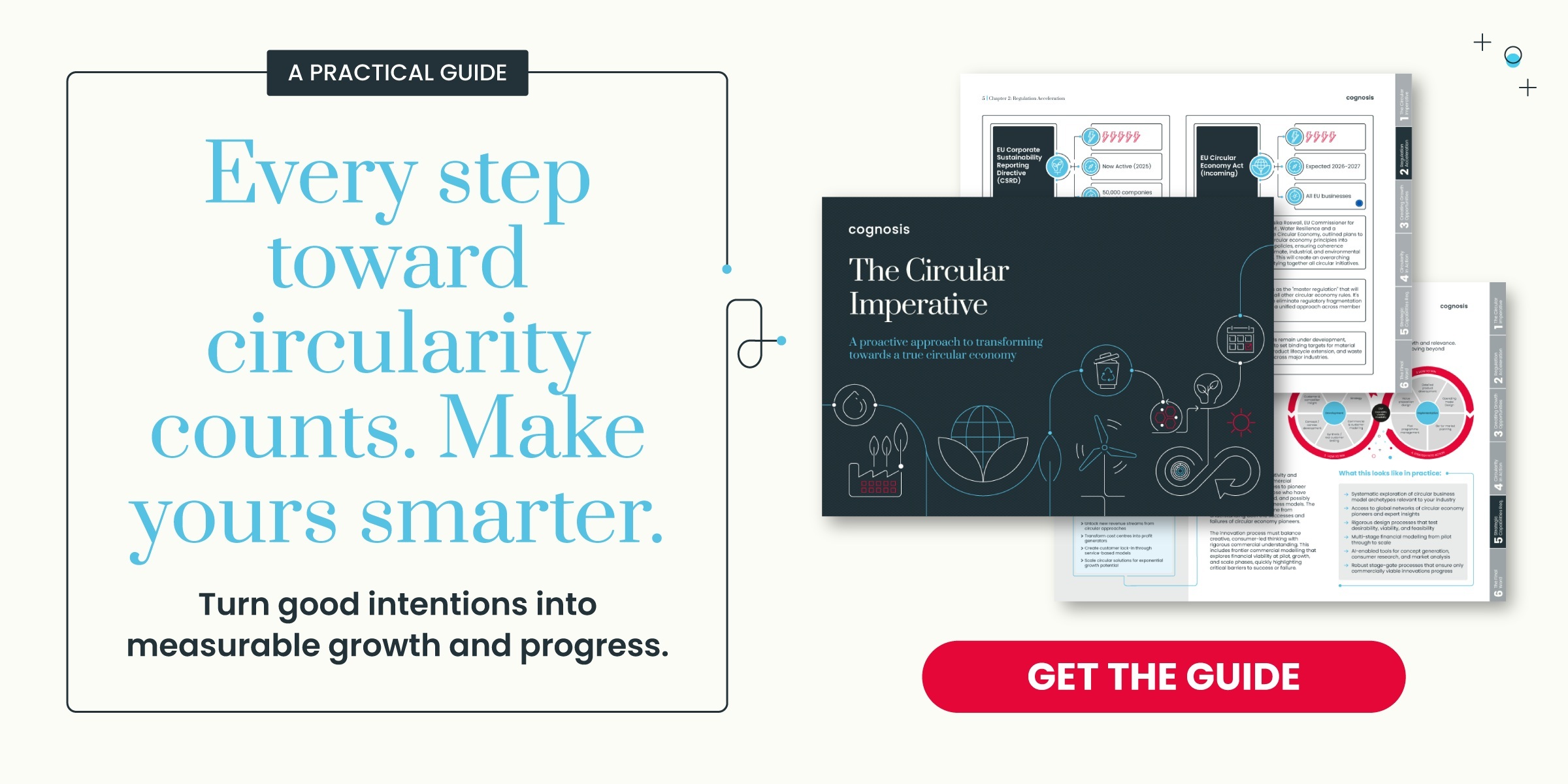
> CIRCUARITY IS POSSIBLE: A guide to help leaders discover how to unlock the next frontier
Circular challenges: good intentions are no guarantee of success
While the case for circularity has clear merits – especially with the prospect of supportive regulation – the reality of adopting circular practices is altogether muddier. The effort is justifiable, but getting started is still taxing.
We conducted interviews with businesses that have already started on their circular journey and making good progress. They shared valuable insights around the upfront challenges of circularity, particularly the need to make the economics work and demonstrate robust ROI to senior leadership.
It’s understandable, therefore, that launching full-scale into circularity can feel like commercial hari-kari for many business leaders. Unlike start-ups that have designed their entire approach to value creation on a circular model, traditional linear businesses simply aren’t built that way. The uncomfortable truth is that the long-term rewards of circularity can seem eclipsed by the near-term dangers to their core business.
Circular maturity is still a mixed picture across industry
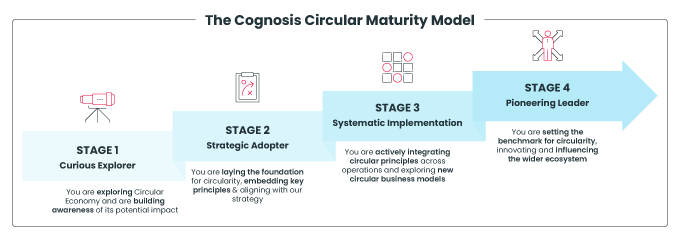
There is a spectrum of circular maturity, with pioneers at one end and those just setting out at the other. Leaders of circularity are systematically implementing circular principles across their operations. They have set circular economy principles as a core value, and they are actively developing a range of circular value propositions and business models.
Some companies sit at the middle of the spectrum. They are incorporating circular principles into their business strategy, drafting up clear goals, metrics and KPIs, progressing pilot initiatives and ringfencing budgets.
However, the vast majority of businesses are still at the exploratory stage. If your business has no formal circular economy strategy, limited investment and fragmented stakeholder engagement – then you’re not alone.
Here are four action points that will help put the right foundations in place and kickstart the circular conversation:
Action point 1: Imagine what 2035 looks like – from the top
Senior management support is critical for turning circularity from an area of interest into a commitment within the overall business strategy. Appointing a circular champion on the board will send a powerful message of intent.
When the executive team next gathers to set the business horizon, they should include circularity as part of their efforts to build a clear and credible view of what the industry will look like in 10 years’ time.
Constructing this future view doesn’t need to be exhaustive, but consider the following topics:
- Likelihood of circular regulation in your key geographies
- Pace and focus of disruptive circular innovation in your industry
- Shifts in consumer demand & behaviour
- Sources of data, analysis & monitoring around circularity
- Competitive intensity & investment in circular business models
- Investor appetite for circular innovation
Action point 2: Identify opportunities for innovation
Once you have a view on the type and scale of change your industry is likely to experience in the future, you can then review your value chain and identify the key opportunities for circularity.
Much will depend on your current position on the maturity spectrum. Optimising the current linear value chain by ramping up material recycling, regeneration, reuse etc could prove an entry point for circularity. For others, new proposition development and business model innovation will deliver competitive advantages and offer resilience.
A good working understanding of the kinds of circular innovations and start-ups that are driving new models across your value chain is essential. Help is at hand in the form of Cognosis’ repository for circular business model innovations, which details where and how new ideas and partnerships are taking shape. Our research reveals the four distinct types of innovation that circular-minded businesses are currently developing:

- Anything as-a-Service Models – Product ownership is retained, and use is offered through subscription or rental models.
- Circular Marketplaces – Platforms facilitate the exchange or use of second-hand refurbished or recycled products.
- Enabling Services – Closing the loop of product, component and material life cycles through recovery and reintegration.
- Recovery Services – Tools and platforms supporting circular models that allow the circular economy to function.
The ultimate aim is to pinpoint and prioritise the most critical circular opportunities across the value chain for business model innovation in the near, mid and long term.
Action point 3 - Establish a credible vision and goals
Based on your future view and value chain assessment you can start to build alignment on company ambitions. This vision will be different in scope, scale and ambition for every business, but crucially it puts a marker down for the pace and scale of business model change the organisation wants or needs to drive. In time, government regulation will help to increase momentum for those further down the track.
Businesses should also think about how to measure the success of circular business models. Do you treat them with the same KPIs and timeframes as regular innovation, given their distance from core business ideas? Are there other significant benefits from circular initiatives on the business beyond monetary ROI – for example in material efficiency and cost savings, reduced waste, stakeholder relations, access to new markets and talent attraction.
Sustainability trailblazer Patagonia, an example of a pioneering leader, has pledged that all its clothing will be recyclable or re-purposable at the end of its useful life, encouraging customers to trade in and then buy used goods.
Your initial vision and goals may be more modest, potentially outlining an ambition to design and launch a few pilots. You don’t need to change the world at the first attempt. Just getting up and running is a good start.
Furniture giant Ikea is loudly transitioning towards becoming a circular business and has committed to design all its products with circular capabilities, using renewable or recycled materials. They are also innovating circular services that encourage customers to extend the life of their favourite table or exchange a chair on a community platform.
Action point 4 – Circular roadmap: Design for now with the future in mind
Our meetings with circular leaders revealed the importance of crafting a practical roadmap for achieving circular aspirations. The long-term destination may be set, but charting how to get there is less straightforward – and will likely adapt with time.
In the short term, it pays to scope out success stories elsewhere in the market and identify initiatives that present lower risk. Initially, these pilots should be designed for now, aiming to solve current consumer problems, rather than simply trying to ‘circularise’ existing products and services.
Small wins will bring much needed momentum. Take those small wins to other parts of the business, then grow from there. Interviewees talked about the need to “box clever” and avoid getting drawn into risky new models too soon.
A more circular system has to be no less convenient – and ideally more convenient – because consumers are busy...consumers won’t pay a premium to do the right thing. So you need to make it cost neutral decision. | Will Ghali, CEO of packaging compliance scheme Ecosurety.
All too often, circular innovation fails as the solutions are built for needs that have not matured. Or good ideas can fizzle out, as they are too far from the core strategy. New solutions that are not underpinned by the necessary infrastructure or systems, without support from decision makers and the whole value chain, are less likely to succeed. They are the right concepts, yes, but they’ve come at the wrong time.
It therefore pays to focus pilots on areas where you can build some momentum and start gathering learning and experience.
If you’ve started a circular economy strategy, you’re already ahead
As we transition to a circular future, there are no quick fixes. Take your time, test rigorously and improve incrementally, as with any new proposition development. There will be winners and losers. But this is not the moment to panic. Most large linear businesses are still at the start of this journey and the revolution won’t happen overnight. However, it is critical that you do start thinking about this challenge today.